

Hey there, tractor enthusiasts! As a supplier of 140hp large wheeled tractors, I get asked a ton of questions about our machines. One of the most common ones is, "What's the maximum slope a 140hp large wheeled tractor can climb?" Well, let's dive into this topic and find out!
First off, it's important to understand that there isn't a one - size - fits - all answer to this question. The maximum slope a 140hp wheeled tractor can handle depends on several factors.
Factors Affecting the Tractor's Climbing Ability
1. Tractor Design and Weight Distribution
The way a tractor is designed plays a huge part. Our 140hp large wheeled tractors are engineered with a good center of gravity. This helps in maintaining stability while climbing slopes. The weight is evenly distributed across the wheels, which gives better traction. If the weight is not distributed properly, the tractor might tip over or lose traction easily. For example, if too much weight is at the front, the rear wheels might lose grip, especially on steep slopes.
2. Tire Traction
Tires are like the shoes of the tractor. The type of tires fitted on the tractor can significantly impact its climbing ability. Our tractors usually come with high - quality, deep - treaded tires that are designed for good traction on various terrains. On slopes, these tires dig into the ground, providing the necessary grip. If the tires are worn out or if they're not suitable for the terrain, the tractor won't be able to climb steep slopes as effectively.
3. Surface Conditions
The surface of the slope matters a lot. A dry, solid, and gravelly slope is easier to climb than a wet, muddy, or slippery one. On a dry slope, the tires can get a better grip, and the tractor's engine can transfer the power more efficiently to move the vehicle up the incline. But on a wet or muddy slope, the lack of friction can cause the tires to spin, making it difficult for the tractor to make progress.
4. Engine Power and Torque
Our 140hp tractors are mighty machines. The 140 horsepower provides the necessary strength to pull the tractor up a slope. But it's not just about the horsepower. Torque, which is the rotational force, is also crucial. A tractor with high torque can start moving from a standstill on a slope more easily. Our engines are tuned to provide a good balance of power and torque, which gives an edge when climbing.
Calculating the Maximum Slope
To get a rough idea of the maximum slope, we can consider some basic physics. The force required to move a tractor up a slope is a combination of the tractor's weight, the slope angle, and the friction between the tires and the ground.
Let's say the tractor weighs (W) pounds. The force acting on the tractor due to gravity along the slope is (F = W\times\sin\theta), where (\theta) is the angle of the slope. The tractive force provided by the tractor's engine must be greater than or equal to this gravitational force for the tractor to climb.
In general, for our 140hp large wheeled tractors, under ideal conditions (dry, solid surface, proper tire traction), we can say that they can handle slopes of up to around 20 - 30 degrees. But remember, this is a rough estimate. If the conditions are not ideal, like on a wet or muddy slope, the maximum angle might reduce to around 10 - 20 degrees.

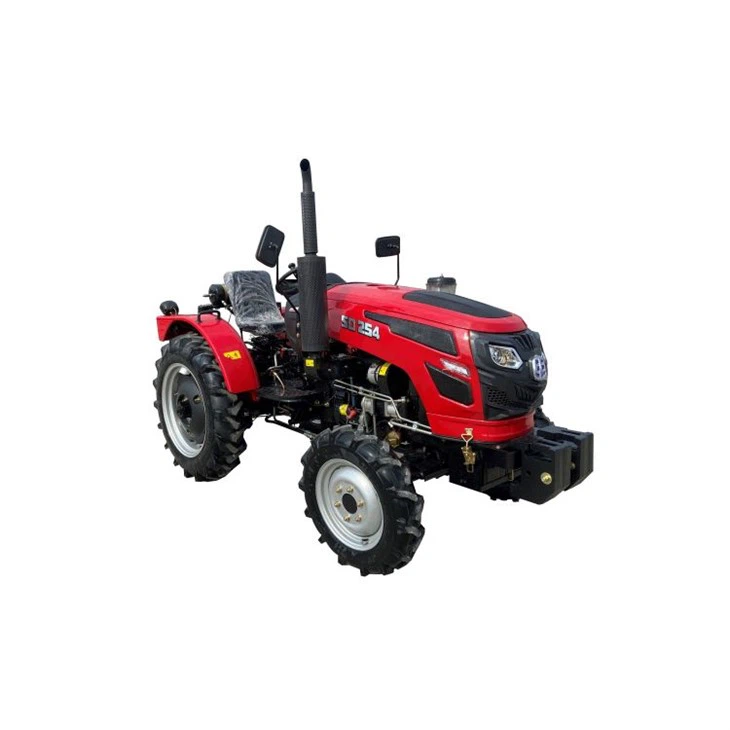
Comparing with Other Tractors
We also have other tractors in our lineup, like the Compact Tractor with Loader and the 25hp Mini Wheeled Tractor and 260HP Big Tractor.
The compact tractor with loader is more suitable for smaller jobs and less steep slopes. Due to its smaller size and power, it might handle slopes up to around 15 degrees. The 25hp mini wheeled tractor has limited power, so it can probably manage slopes of up to 10 - 12 degrees. On the other hand, our 260HP big tractor, with its much higher power, can take on steeper slopes, possibly up to 35 - 40 degrees under ideal conditions.
Safety First
When operating a tractor on slopes, safety should always be the top priority. Even if our 140hp large wheeled tractors can handle relatively steep slopes, it's important to follow some safety guidelines.
- Inspect the Tractor: Before climbing a slope, make sure the tractor is in good working condition. Check the tires, brakes, and engine.
- Use the Right Gear: Select the appropriate gear to maintain a steady speed. Don't try to rush up the slope.
- Be Aware of the Surroundings: Look out for any obstacles or changes in the terrain.
Why Choose Our 140hp Large Wheeled Tractors
Our 140hp large wheeled tractors offer a great combination of power, performance, and reliability. They are built with the latest technology and high - quality materials. Whether you're working on a farm, a construction site, or in a forest, these tractors can get the job done.
If you're in the market for a reliable tractor that can handle slopes and various tasks, we'd love to talk to you. Our team of experts can help you choose the right tractor for your specific needs. Whether it's about the maximum slope ability or other features, we're here to answer all your questions. So, don't hesitate to reach out for a procurement discussion. We're committed to providing you with the best tractor solutions at a great price.
References
- Engineering Principles for Agricultural Equipment, Second Edition by Jay O. Lowell
- Tractor Mechanics Handbook by Paul Dempsey


