


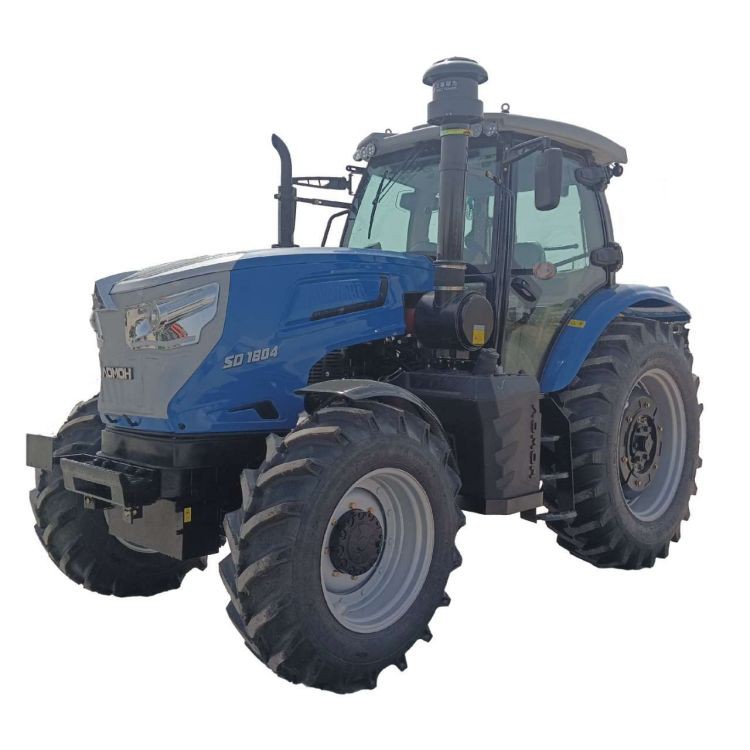
260hp Big Farm Wheeled Farm Tractor
Sadin Holding Group is an agricultural equipment manufacturer integrating R&D, production and sales. It was established in 2013. Sadin International trade Responsible for the group's external export business. Now has two major industrial parks with a total area of nearly 700,000 square meters and a total investment of 5 billion yuan (approximately 800 million US dollars), with a total annual output of 150,000 agricultural equipment.
Why Choose Us
Quality control
In the processing of production, our professional technical engineers inspect the processing to ensure the quality of products,After our machine finish , our engineer will make 24 hours test constantly and ensure the machine reach to the best performance.
One stop solution
From the begining inquiry and throughout the entire process until you receive the goods. we are dedicated to supporting you every step of the way.
Innovation
We are dedicated to improving our systems continually, ensuring that the technology we offer is always cutting edge.al way.
Competitive Price
We have professional sourcing team and cost accounting team, stive to reduce cost and profit and provide you a good price.

260hp Big Farm Wheeled Farm Tractor
The 260hp Big Farm Wheeled Farm Tractor is powerful and suitable for all types of complex working environments.

This 25hp Mini Wheeled Tractor has been sold all over the world for many years and has been recognized by countless customers.

Compact tractor body specially designed for orchard surroundings, allowing you to flexibly shuttle in orchards.

40hp Wheeled Tractor With Roof
If you are looking for a mini Wheeled Tractor, this 40hp Wheeled Tractor With Roof is sure to satisfy you!

This tractor is one of our company's most popular products, with approximately a thousand units sold worldwide throughout the year.

60hp Wheeled Tractor With Cabin
If you are looking for a mini Wheeled Tractor With a cab, then this 60hp Wheeled Tractor With Cabin must be a good choice!

70hp Wheeled Tractor With Roof
If you are looking for a mini Wheeled Tractor With a cab, then this 70hp Wheeled Tractor With Roof must be a good choice!

If your farm needs a tractor that can withstand the cold, then this tractor is a good choice!

This 30hp Wheeled Tractor With Cab, there are convertible version, sunshade version, cab and many other versions!
A tractor is an engineering vehicle specifically designed to deliver a high tractive effort (or torque) at slow speeds, for the purposes of hauling a trailer or machinery such as that used in agriculture, mining or construction.
Benefits of 260hp Big Farm Wheeled Farm Tractor
Get Improved Performance
A four-wheel drive system transfers engine power to all four wheels, instead of just to two. In other words, more power is able to go to more parts of the vehicle.
Get More Implement Options
Implements are a great resource. They expand a tractor's capacity, allowing owners to handle a wider range of tasks (and avoid buying a second piece of equipment).
Navigate Poor Work Sites
Sometimes, work sites are less than ideal. For example, a heavy rain can turn fields into muddy areas of land. Not all tractors are well-suited for compromised work sites. But 4WD tractors can handle the mud with ease! You won't need to worry about muddy conditions derailing your projects or timelines. Instead, head out and get your to-do list finished without skipping a beat.
Get Improved Traction
The more difficult your terrain is to navigate, the more important traction becomes. For example, maybe your property contains slopes or rocky areas. Some tractors won't be able to handle those challenges. Four wheel drive tractors, however, have improved traction. The front wheels assist the back wheels in moving the vehicle forward, which increases the traction in the back wheels. Enjoy reduced slippage and improved control when you use a 4WD tractor.
How a wheeled tractor works
A wheeled tractor is a type of tractor, that is, a tractor whose running device is a wheel (different from a crawler tractor) has two-wheel (walking tractor), four-wheel and other types. Divided into rear-wheel drive and four-wheel drive. The high-horsepower wheeled tractor has good traction performance and is suitable for high-speed operation with wide-width agricultural tools on large farms.
The working principle of the wheeled tractor's running, the tractor can run by the power of the internal combustion engine through the transmission system, so that the driving wheel obtains the driving torque Mk, and the driving wheel that obtains the driving torque then gives the ground a small and backward horizontal action through the tire pattern and tire surface. force (tangential force), and the ground faces the horizontal reaction force Pk with the same magnitude and opposite direction as the driving force.
When the driving force Pk is enough to overcome the forward rolling resistance of the front and rear wheels and the traction resistance of the agricultural implements, the tractor will move forward. If the driving wheel is lifted off the ground, that is, the driving force Pk is equal to zero, the driving wheel can only be idling on the spot. Cannot drive; if the sum of rolling resistance and traction resistance is greater than the driving force Pk, the tractor cannot drive. It can be seen that the driving of the wheeled tractor is realized by the interaction between the driving torque driving wheel and the ground, and the driving force is greater than the sum of the rolling resistance and the traction resistance.
4-wheel Tractor Structural Explanation
(1)Transmission system
Including clutches, gearboxes, central drives and final drives, etc.
(2)Walking system
It is a device used to support the weight of the tractor body, ensure the driving performance of the tractor, and convert the driving torque transmitted by the engine to the driving wheel into traction force. The walking system of wheeled tractors consists of a frame, walking wheels and a front axle. The front wheels of four-wheel tractors are guide wheels and the rear wheels are drive wheels.
(3)Steering system
The steering system of wheeled tractors can be divided into three types: mechanical, hydraulic power assisted and cold hydraulic. Steering modes can be divided into front wheel steering, rear wheel steering, four-wheel steering and folding steering. Most general wheeled tractors use front wheel steering.
(4)Brake system
When the tractor is running, it will generate resistance torque to the driving wheel to reduce the speed or stop the rotation, so as to realize gradual stop or emergency braking. The cab is equipped with brake pedal and hand brake lever to control the brake. There are block, belt and disc brakes.
(5)Working device
5.1 PTO. Includes PTO shaft and PTO belt
5.2 Traction device
Traction connection is the simplest, that is, there is a traction device behind the tractor, which directly connects the traction agricultural machinery or trailer at one point. It is divided into fixed type and swing rod type.
5.3 Hydraulic suspension device
(6)Electrical equipment
The tractor electrical system is mainly composed of power supply and electrical equipment. The main function is to start the engine, send the signals required to ensure the safe driving of the tractor and lighting, which is composed of power supply equipment, electrical equipment and power distribution equipment.
Vehicle owners who regularly maintain their tractor wheels can always tell it's time for a replacement. If your tractor has modern tires, the slip indicator will record your tractor's slip rate making it easy to determine whether you need a replacement or not. However, precisely determining if you have the old wheels may be difficult, and you may need to deploy your experience as an operator. One helpful indicator is checking how far the dirt is pushed backward by the lugs in the tire tracks. If you notice that the slips have increased, go ahead and check out for other signs such as:
Unusual Vibrations
They come as a result of very low or unevenly distributed tire treads. You will typically hear the vibrations when you are speeding or slowing down.
Deflated Wheels
Deflated wheels are caused by a lack of air pressure. They are prone to damage and need to be fixed as soon as possible.
Irregular Wear
If your tractor wheels don't have enough pressure, they will start wearing unevenly. The uneven wear causes the outer parts of the tread to come into contact with the road causing more tread wear.
Presence of Cuts or Bulges On the Surface of the Tires
The constant work and impact from the road can cause cuts and bulges on your wheels. These cuts and bulges are not good for your safety, and if not fixed on time, they can interfere with your tractor's performance.
Cracks Due to Dryness
With time, the wheel materials may dry up and harden, causing cracks. The cracks interfere with the wheel's flexibility and eventually lead to tread separation if left unchecked.
Correct Operating Methods For Wheeled Tractors
Do not forcefully lift the clutch when starting.
Slowly release the clutch pedal and increase the throttle appropriately while driving, otherwise it may cause impact or even damage to the clutch assembly and transmission components.
The auxiliary clutch cannot be pulled up (disengaged) for a long time, otherwise it will cause early damage to the clutch, and attention should be paid.
Tractors are strictly prohibited from shifting to neutral or stepping on the clutch pedal to slide downhill.
Steering of the tractor.
When turning the tractor, the throttle should be reduced or when shifting to a low gear, and unilateral braking should not be used for sharp turns.
Shift and working speed selection of tractors.
- The shifting and working speed selection of the tractor will cause the clutch assembly to operate the steering wheel to achieve steering when the tractor's driving speed decreases.
- When the tractor is traveling at high speed, selecting the correct working speed can not only achieve better productivity and economy, but also extend the service life of the tractor.
- When the tractor is working, it should not be overloaded frequently, and the engine should have a certain power reserve.
- The selection of tractor field working speed should ensure that the engine operates at around 80% load.
Use of tractor differential lock.
- When the tractor is in operation, the differential lock generally remains disengaged.
- When the rear wheel of the tractor slips severely or gets stuck in a pit, the differential lock control pedal should be pressed and held in this position to engage the differential lock and drive the tractor out of the slipping area.
- When the differential lock is engaged, the tractor cannot turn, otherwise it will cause abnormal tire wear, damage to the central transmission, and even rollover.
Tractor braking.
- In general, the engine throttle should be reduced first, then the main clutch pedal should be pressed, and then the driving brake control pedal should be gradually pressed to make the tractor come to a smooth stop.
- When emergency braking, both the main clutch pedal and the driving brake control pedal should be pressed simultaneously.
- During driving, drivers are not allowed to place their feet on the brake pedal or clutch pedal.
- Special reminder:
- When the tractor is driving on the road, be sure to interlock the left and right brake pedals.
- When the tractor is parked on a slope, it should wait for the engine to stop, and before releasing the driving brake pedal, first shift to up gear. When going uphill, shift to forward gear, and when going downhill, shift to gear.
Front wheel drive control.
When the tractor is carrying out heavy load operations in the field or working on damp and soft soil, it is usually connected to the front drive axle for operation. When the tractor is carrying out general transportation operations on hard roads, it is not allowed to connect the front drive axle, otherwise it will cause early wear of the front wheels.
Hydraulic output valve and its control realize four-wheel drive operation.
- Tractors are equipped with single acting or double acting hydraulic output valves, and the hydraulic output valve control handle controls the single acting or double acting oil cylinder on agricultural tools.
- Before leaving the factory, the hydraulic output valve of the pulling machine is adjusted to double acting. If a single acting agricultural tool is required, the user can adjust it to single acting hydraulic output.
Tractor oil requirements:
① Choose different grades of diesel according to different environments and seasons. It is strictly prohibited to mix diesel of different grades.
② The fuel and transmission hydraulic dual-use oil added to the fuel tank must be filtered or precipitated for at least 48 hours before being added for use.
③ During engine operation, do not add fuel to the fuel tank. If the tractor is working in hot or sunny conditions, the fuel tank cannot be filled up. Otherwise, the fuel will overflow due to expansion, and once it overflows, it should be wiped dry immediately.
Our Factory
Our factory has three major assembly workshops and three wheeled tractor production lines.
In order to build the most advanced high-end intelligent production line in this industry, we invested 300 million yuan (approximately 50 million US dollars) to construct a new first assembly workshop with an annual output of 30,000 wheeled tractors. The workshop covers an area of more than 70,000 square meters, including 56 processes and 306 operation steps. It has multiple automatic assembly lines such as gearbox assembly line, rear axle assembly line, chassis assembly line, chassis painting line, and final assembly line.

Certifications

FAQ
Hot Tags: 260hp big farm wheeled farm tractor, China 260hp big farm wheeled farm tractor manufacturers, suppliers, factory, tractor smallholder tractor, rear wheel drive wheeled tractor, tractor dairy tractor, heavy duty wheeled tractor, tractor spare parts, wheeled tractor manufacturing process
You Might Also Like


Send Inquiry